
– To Sven, Nadine, Carsten, Verena, Holger, Eva, Tina and Tosja.
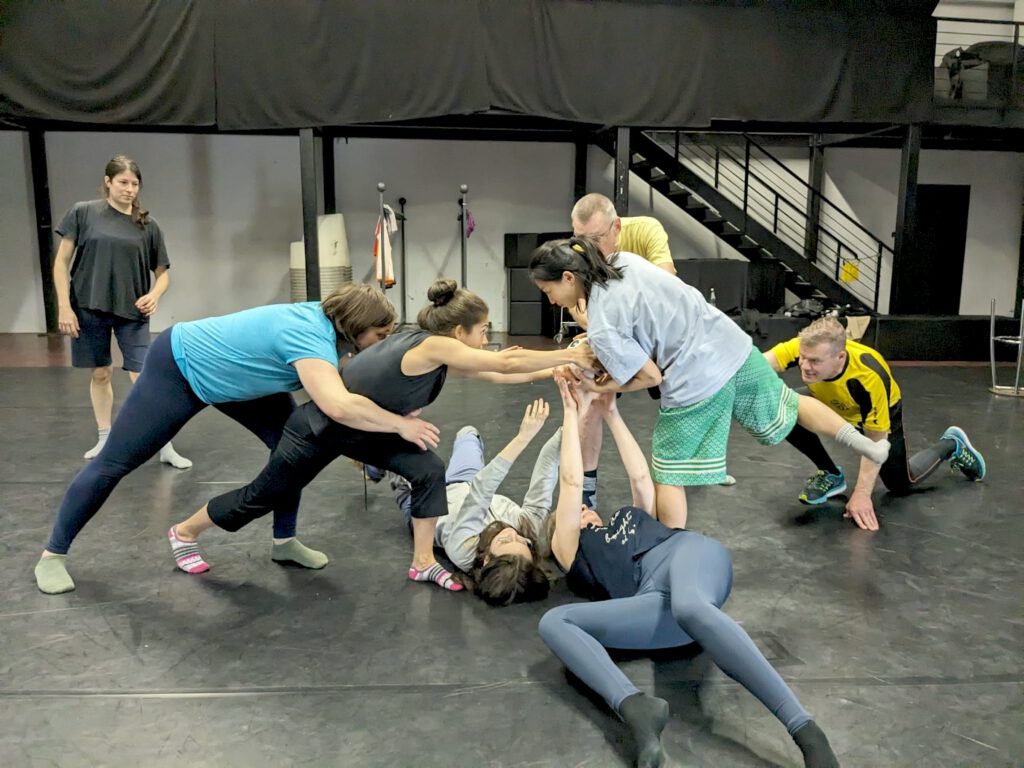
I cherish the moments when a hunch transforms into a decision, allowing thoughts and sensations to emerge as actions beyond oneself. I patiently wait for that magical moment in a rehearsal when a spiral of transformations occurs, and everyone becomes engaged intuitively in the creative process. Sensations transform into actions and actions trigger new sensations in the others, who in their own way start communicating their own decisions and bringing in actions in the shared space – the material morphs in waves. Our attentive senses are already warmed up and the engine of the creative Mobius is on.
This creative state appeared on the third day of rehearsal with the participants of our piece “Ohne-Wasser Rugby: Club Darlington e.V.”, a commission from Impulse Theater Festival to work on a performance for SCHWIMM CITY in Mülheim an der Ruhr, in collaboration with sport players of the niche sport Subaquatic Rugby.
To my surprise, the creative Mobius somehow survived the long pauses between our sessions, leaving open access to this state of awareness when we met again with the participants. I am very intrigued by why and how this happened. I feel a false assumption breaking down and it is quite satisfying to let it go. From professional artists, it is expected to have the ability to call this creative state at our wish, which despite practice, is not always possible. You can practice the invitation, but you cannot force the state. I assumed that for the participants of the project, this would be a significant obstacle to overcome since it was the first time for them to participate in a choreographic project as co-authors and performers. I was wrong.
The choreographic portrait was a collaborative creation. I attended several trainings at Hallenbad Süd in Mülheim an der Ruhr with the mixed team of TSC Mülheim/Ruhr e.V., and in Duisburg with the women’s team of FS Duisburg. I also watched a match between the teams of Cologne and Münster. To me, it was crucial to experience the sport first-hand, have the feeling in my body, and incorporate it into the creative process. I was surprised and thankful, that during the rehearsals, I wasn’t the only one bringing in the memory of the sport into the rehearsal space. The performers eventually started to make their own propositions and observations on how the sport feels for them and how they could place this physical memory in this very different setting, feeling the gravity in another way due to the lack of water. Although we used different concepts for what was happening, we were going on the same path.
For instance, we didn’t need to explain that we work with improvisation and instant composition, as they were doing it instinctively. They accepted our invitation to enter the creative state with little to no resistance and minimal explanation. At times we needed to shift the focus from logical observation to an embodied state. However, a simple declaration of „we are doing art“ from one of the participants was enough to restore the creative state and reorganize the modes of observation, decisions, and actions occurring in the space.
The rehearsals felt more like a translation between practices rather than an explanation from our side, and this matches beautifully how I understand and like to be in these worlds. In this project, we met halfway. Sometimes we replaced our terminology and used theirs like the term „signal“ rather than „cue“ to denote the trigger for actions along the choreographic score. They were familiar with this and other elements we use in our work but just used other words, they understood how to stay alert to signals, how to playfully act upon them, and even how to find the cracks between the score to suggest new directions for the whole performance. Their response to our choreographic method was brilliant. They are brilliant performers with a profound sense for their body, for the shared space, for emergence, for recalling a physicality, and for being present.
This experience has been incredibly enriching for all involved. Although I can’t speak for the performers, it has inspired my fellow artists at TachoTinta and me to continue developing this practice. Maybe this was implicit in our work the whole time, but it is now evident that we don’t only want to become experts in cultural misunderstandings, but also experts in keeping that open access to shared artistic states of being, regardless of distance, time and profession. We’re eager to create spaces in which everyone is an expert of their own body and an author of their own story. In these spaces we meet halfway, we can share, mix, and transform – and maybe, if we want it – we create choreographic portraits of ourselves.
Thank you, Sven, Nadine, Carsten, Verena, Holger, Eva, Tina, and Tosja for triggering this new additional path for TachoTinta!
And thank you Anna and Heiko for inviting us to participate in Schwimm City and creating the frame for all this.